
-
Cardio Equipment
- Cardio Equipment
-
Strength Training Equipment
- Strength Training Equipment
-
Hydraulic Fitness
- Hydraulic Fitness
The CT3-H107 works the chest and the upper back through the same horizontal arc, reversed — pectoral fly closing the arms in front of the body, rear deltoid opening them behind it.
The open frame allows users to roll directly into the training position from their own wheelchair, with no transfer and no assistance required.
The rear deltoid movement is the more clinically valuable of the two. Rounded shoulders and a forward head position are among the most common postural consequences of prolonged seated time and wheelchair propulsion, and the rear deltoids and mid-trapezius are the muscles that resist it. Training them directly against the pectoral fly gives a therapist both halves of the pattern from one station, and lets a programme be weighted deliberately toward whichever side needs the work.
Resistance runs from 35 N to 80 N across six positions — light enough to be prescribed early in recovery, and adjustable in small increments as range returns. Adjustment is made at the machine without tools.
The CT3-H107 has the widest movement envelope in the range at 134 cm, reflecting the horizontal arc the exercise requires. Every wear item carries a manufacturer part number, and the station shares its wear-part platform with the rest of the accessible range.
Key features
- Wheelchair accessible — open frame, no transfer required
- Two exercises, one station — pectoral fly and rear deltoid
- Targets seated posture — direct rear deltoid and mid-back work
- Six resistance positions — 35 N to 80 N, calibrated for rehabilitation
- Tool-free adjustment — users set their own resistance
- Full spare-parts support — every wear item carries a part number
Specifications
| Model | CT3-H107 |
| Series | Vertex CT3-H Accessible |
| Function | Pectoral fly / rear deltoid |
| Assembled size (L × W × H) | 120 × 134 × 174 cm |
| Floor footprint | 1.20 × 1.34 m |
| Resistance positions | 6 |
| Resistance range | 35 N – 80 N |
| Net weight | 118.5 kg |
| Gross weight | 136 kg |
| Carton size (L × W × H) | 1400 × 1000 × 400 mm |
| Shipping volume | 0.56 CBM |
| Application | Rehabilitation, physiotherapy, senior care, inclusive fitness |
- Home
- Strength Training Equipment
- CT3-H107 Pectoral Fly / Real Deltoid for Disabled Person use (Wheelchair Accessible)
CT3-H107 Pectoral Fly / Real Deltoid for Disabled Person use (Wheelchair Accessible)
| VARIANT | SELLER | PRICE | QUANTITY |
|---|
CT3-H107 Pectoral Fly / Real Deltoid for Disabled Person use (Wheelchair Accessible)
Description of product
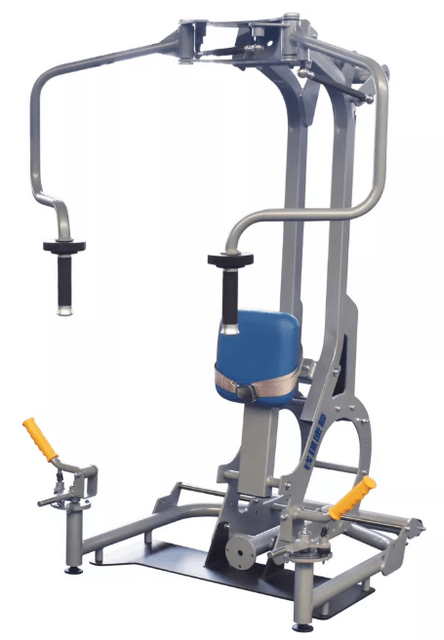
The CT3-H107 works the chest and the upper back through the same horizontal arc, reversed — pectoral fly closing the arms in front of the body, rear deltoid opening them behind it.
The open frame allows users to roll directly into the training position from their own wheelchair, with no transfer and no assistance required.
The rear deltoid movement is the more clinically valuable of the two. Rounded shoulders and a forward head position are among the most common postural consequences of prolonged seated time and wheelchair propulsion, and the rear deltoids and mid-trapezius are the muscles that resist it. Training them directly against the pectoral fly gives a therapist both halves of the pattern from one station, and lets a programme be weighted deliberately toward whichever side needs the work.
Resistance runs from 35 N to 80 N across six positions — light enough to be prescribed early in recovery, and adjustable in small increments as range returns. Adjustment is made at the machine without tools.
The CT3-H107 has the widest movement envelope in the range at 134 cm, reflecting the horizontal arc the exercise requires. Every wear item carries a manufacturer part number, and the station shares its wear-part platform with the rest of the accessible range.
Key features
- Wheelchair accessible — open frame, no transfer required
- Two exercises, one station — pectoral fly and rear deltoid
- Targets seated posture — direct rear deltoid and mid-back work
- Six resistance positions — 35 N to 80 N, calibrated for rehabilitation
- Tool-free adjustment — users set their own resistance
- Full spare-parts support — every wear item carries a part number
Specifications
| Model | CT3-H107 |
| Series | Vertex CT3-H Accessible |
| Function | Pectoral fly / rear deltoid |
| Assembled size (L × W × H) | 120 × 134 × 174 cm |
| Floor footprint | 1.20 × 1.34 m |
| Resistance positions | 6 |
| Resistance range | 35 N – 80 N |
| Net weight | 118.5 kg |
| Gross weight | 136 kg |
| Carton size (L × W × H) | 1400 × 1000 × 400 mm |
| Shipping volume | 0.56 CBM |
| Application | Rehabilitation, physiotherapy, senior care, inclusive fitness |
The CT3-H107 works the chest and the upper back through the same horizontal arc, reversed — pectoral fly closing the arms in front of the body, rear deltoid opening them behind it.
The open frame allows users to roll directly into the training position from their own wheelchair, with no transfer and no assistance required.
The rear deltoid movement is the more clinically valuable of the two. Rounded shoulders and a forward head position are among the most common postural consequences of prolonged seated time and wheelchair propulsion, and the rear deltoids and mid-trapezius are the muscles that resist it. Training them directly against the pectoral fly gives a therapist both halves of the pattern from one station, and lets a programme be weighted deliberately toward whichever side needs the work.
Resistance runs from 35 N to 80 N across six positions — light enough to be prescribed early in recovery, and adjustable in small increments as range returns. Adjustment is made at the machine without tools.
The CT3-H107 has the widest movement envelope in the range at 134 cm, reflecting the horizontal arc the exercise requires. Every wear item carries a manufacturer part number, and the station shares its wear-part platform with the rest of the accessible range.
Key features
- Wheelchair accessible — open frame, no transfer required
- Two exercises, one station — pectoral fly and rear deltoid
- Targets seated posture — direct rear deltoid and mid-back work
- Six resistance positions — 35 N to 80 N, calibrated for rehabilitation
- Tool-free adjustment — users set their own resistance
- Full spare-parts support — every wear item carries a part number
Specifications
| Model | CT3-H107 |
| Series | Vertex CT3-H Accessible |
| Function | Pectoral fly / rear deltoid |
| Assembled size (L × W × H) | 120 × 134 × 174 cm |
| Floor footprint | 1.20 × 1.34 m |
| Resistance positions | 6 |
| Resistance range | 35 N – 80 N |
| Net weight | 118.5 kg |
| Gross weight | 136 kg |
| Carton size (L × W × H) | 1400 × 1000 × 400 mm |
| Shipping volume | 0.56 CBM |
| Application | Rehabilitation, physiotherapy, senior care, inclusive fitness |
Related products

ABOUT THE SHOP
Afton Fitness is India’s leading supplier of premium gym equipment and Pilates equipment for homes, commercial gyms, physiotherapy centers, Pilates studios, corporate wellness spaces, and hotels. We offer a full range of treadmills, cross trainers, exercise bikes, ellipticals, rowing machines, and commercial cardio equipment, along with strength training machines, free weights, benches, racks, functional trainers, and multi-gyms for complete fitness setups.
MY STORE
ADDRESS
2nd Floor, SCM Jamaludeen Chambers, 4 Montieth Road, Egmore
Chennai
Tamil Nadu - 600008
IN