-
Cardio Equipment
- Cardio Equipment
-
Hydraulic Fitness
- Hydraulic Fitness
The CT3-H101 pairs the two foundational horizontal patterns — chest press and seated row — in one wheelchair-accessible station.
The open frame is the point of the machine. Users roll straight into the training position and begin, with no transfer, no assistance and no waiting for a staff member to become free. On a rehabilitation floor, that difference decides whether equipment gets used or gets walked past.
Pressing and rowing from the same station trains the chest, shoulders and triceps against the upper back, rear deltoids and biceps — the opposing pair that governs seated posture. This matters more for wheelchair users than for most populations: daily propulsion works the pushing muscles constantly and the pulling muscles barely at all, and the imbalance shows up as rounded shoulders and shoulder pain. Having both patterns in one place makes balanced programming straightforward.
Resistance runs from 35 N to 80 N across six positions — a deliberately light band, calibrated for rehabilitation, deconditioned and older users rather than performance training. Adjustment is made at the machine without tools, so users change their own setting between sets.
Every wear item carries a manufacturer part number, and the CT3-H101 shares its wear-part platform with the rest of the accessible range, so a single spares kit covers a full circuit.
Key features
Specifications
| Model | CT3-H101 |
|---|---|
| Series | Vertex CT3-H Accessible |
| Function | Chest press / seated row |
| Assembled size (L × W × H) | 121 × 122 × 174 cm |
| Floor footprint | 1.21 × 1.22 m |
| Resistance positions | 6 |
| Resistance range | 35 N – 80 N |
| Net weight | 115.5 kg |
| Gross weight | 129 kg |
| Carton size (L × W × H) | 1400 × 1000 × 400 mm |
| Shipping volume | 0.56 CBM |
| Application | Rehabilitation, physiotherapy, senior care, inclusive fitness |
- Home
- Strength Training Equipment
- CT3-H101 Chest Press / Row for Disabled person (Wheelchair Use)
CT3-H101 Chest Press / Row for Disabled person (Wheelchair Use)
| VARIANT | SELLER | PRICE | QUANTITY |
|---|
CT3-H101 Chest Press / Row for Disabled person (Wheelchair Use)
Description of product
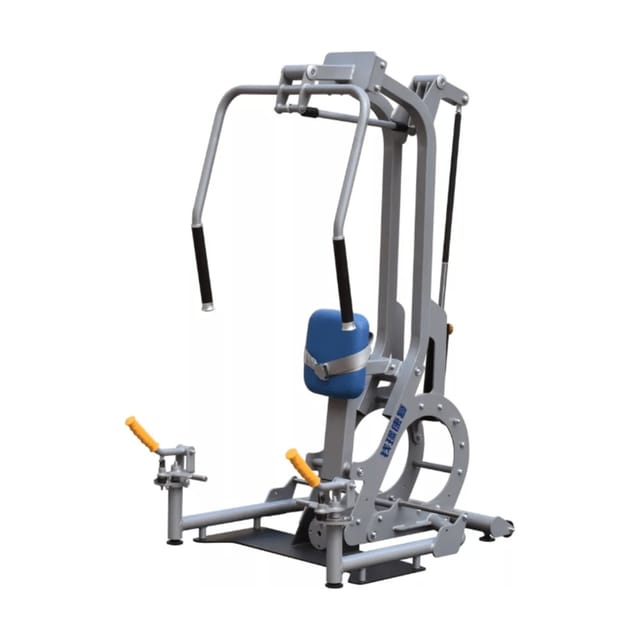
The CT3-H101 pairs the two foundational horizontal patterns — chest press and seated row — in one wheelchair-accessible station.
The open frame is the point of the machine. Users roll straight into the training position and begin, with no transfer, no assistance and no waiting for a staff member to become free. On a rehabilitation floor, that difference decides whether equipment gets used or gets walked past.
Pressing and rowing from the same station trains the chest, shoulders and triceps against the upper back, rear deltoids and biceps — the opposing pair that governs seated posture. This matters more for wheelchair users than for most populations: daily propulsion works the pushing muscles constantly and the pulling muscles barely at all, and the imbalance shows up as rounded shoulders and shoulder pain. Having both patterns in one place makes balanced programming straightforward.
Resistance runs from 35 N to 80 N across six positions — a deliberately light band, calibrated for rehabilitation, deconditioned and older users rather than performance training. Adjustment is made at the machine without tools, so users change their own setting between sets.
Every wear item carries a manufacturer part number, and the CT3-H101 shares its wear-part platform with the rest of the accessible range, so a single spares kit covers a full circuit.
Key features
Specifications
| Model | CT3-H101 |
|---|---|
| Series | Vertex CT3-H Accessible |
| Function | Chest press / seated row |
| Assembled size (L × W × H) | 121 × 122 × 174 cm |
| Floor footprint | 1.21 × 1.22 m |
| Resistance positions | 6 |
| Resistance range | 35 N – 80 N |
| Net weight | 115.5 kg |
| Gross weight | 129 kg |
| Carton size (L × W × H) | 1400 × 1000 × 400 mm |
| Shipping volume | 0.56 CBM |
| Application | Rehabilitation, physiotherapy, senior care, inclusive fitness |
The CT3-H101 pairs the two foundational horizontal patterns — chest press and seated row — in one wheelchair-accessible station.
The open frame is the point of the machine. Users roll straight into the training position and begin, with no transfer, no assistance and no waiting for a staff member to become free. On a rehabilitation floor, that difference decides whether equipment gets used or gets walked past.
Pressing and rowing from the same station trains the chest, shoulders and triceps against the upper back, rear deltoids and biceps — the opposing pair that governs seated posture. This matters more for wheelchair users than for most populations: daily propulsion works the pushing muscles constantly and the pulling muscles barely at all, and the imbalance shows up as rounded shoulders and shoulder pain. Having both patterns in one place makes balanced programming straightforward.
Resistance runs from 35 N to 80 N across six positions — a deliberately light band, calibrated for rehabilitation, deconditioned and older users rather than performance training. Adjustment is made at the machine without tools, so users change their own setting between sets.
Every wear item carries a manufacturer part number, and the CT3-H101 shares its wear-part platform with the rest of the accessible range, so a single spares kit covers a full circuit.
Key features
Specifications
| Model | CT3-H101 |
|---|---|
| Series | Vertex CT3-H Accessible |
| Function | Chest press / seated row |
| Assembled size (L × W × H) | 121 × 122 × 174 cm |
| Floor footprint | 1.21 × 1.22 m |
| Resistance positions | 6 |
| Resistance range | 35 N – 80 N |
| Net weight | 115.5 kg |
| Gross weight | 129 kg |
| Carton size (L × W × H) | 1400 × 1000 × 400 mm |
| Shipping volume | 0.56 CBM |
| Application | Rehabilitation, physiotherapy, senior care, inclusive fitness |
Related products

ABOUT THE SHOP
Afton Fitness is India’s leading supplier of premium gym equipment and Pilates equipment for homes, commercial gyms, physiotherapy centers, Pilates studios, corporate wellness spaces, and hotels. We offer a full range of treadmills, cross trainers, exercise bikes, ellipticals, rowing machines, and commercial cardio equipment, along with strength training machines, free weights, benches, racks, functional trainers, and multi-gyms for complete fitness setups.
MY STORE
ADDRESS
2nd Floor, SCM Jamaludeen Chambers, 4 Montieth Road, Egmore
Chennai
Tamil Nadu - 600008
IN